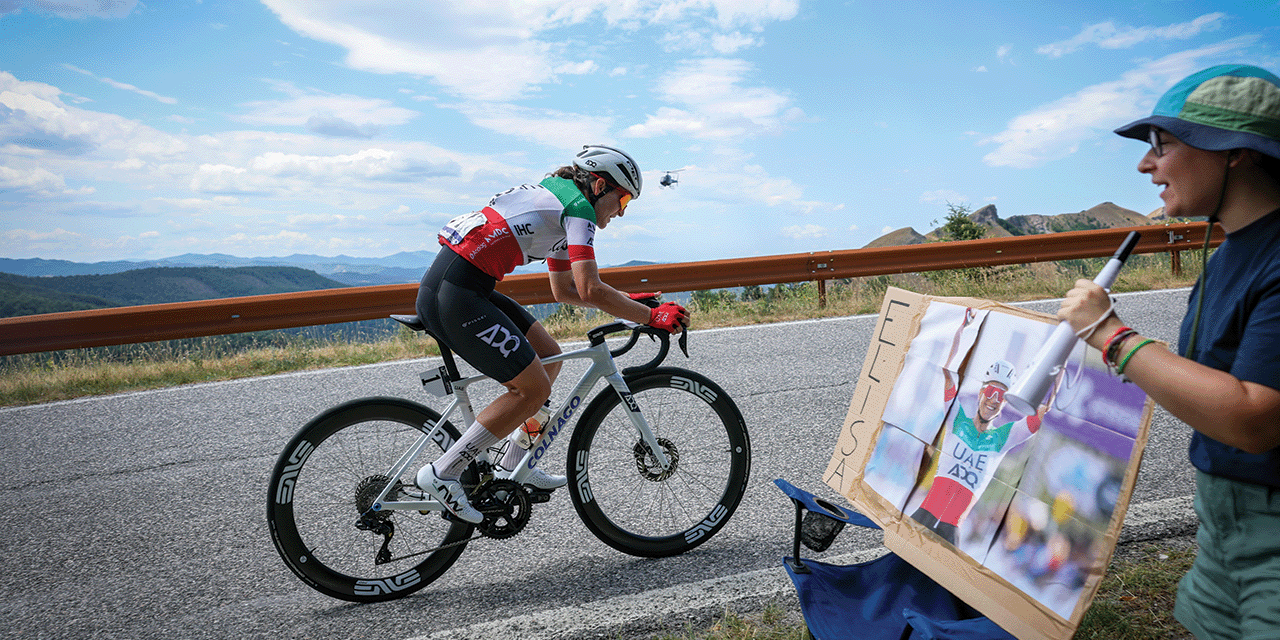
The pink peloton will face over 12,000 metres of total elevation gain at the 2026 Giro d’Italia Women, and most of it is concentrated in four stages which will inevitably shape the general classification. The organisers have opted for a relatively gentle start, with a gradual increase in difficulty that should begin to influence the standings from the fourth fraction.
Stage 4 is designed to deliver the first significant shake-up in the GC. It is a time trial from Belluno to Nevegal, 12.7 km almost entirely uphill – essentially a proper mountain time trial. After leaving Piazza Martiri, the road descends slightly for 1,600 metres, then climbs gently at 3–4% up to kilometre 5.3. From there, the race hits 4.5 km at over 10% average gradient before easing only in the final 1,500 metres. It is a genuine climb that will certainly create the first real gaps.
The following day will be no easier. Just a few days earlier, the men will have battled over Dolomite giants such as Passo Duran, Giau and Falzarego, and now it will be the women’s turn in Stage 5, from Longarone to Santo Stefano di Cadore. The riders will face Passo Tre Croci (7.8 km at 7.5%), the Passo Sant’Antonio (7.6 km at 8.3%), and then climb Costalissoio twice (2.7 km at 10%), the first passage taking them under the finish banner. This stage alone includes 3,200 metres of elevation gain.
By then the GC hierarchy should be quite defined, but the fight for the Maglia Rosa will pass definitively through the penultimate stage, from Rivoli to Sestriere. Stage 8 is only around 100 km long, but at its centre lies the always scary Colle delle Finestre: 18.5 km at 9.2% average gradient, consistent throughout, and with the final 8 km on gravel. At 2,178 metres, this is also the Cima Alfonsina Strada of the 2026 edition. The Finestre will test every rider’s legs, but the stage doesn’t end there: after an 11 km descent comes the climb to Sestriere (16.2 km at 3.8%), gentle on paper but punishing after such brutality. Even the smallest weakness could cost minutes.
If Finestre and Sestriere leave anything unresolved, the riders will have no choice but to stay vigilant in the final stage, starting and finishing in Saluzzo. After the 2,800 metres climbed the day before, the peloton will face another 2,200 metres, including the very hard Montoso climb (9.1 km at 9.2%), though far from the finish, followed by the Colletta di Paesana and the Colletta di Brondello (4.6 km at 7.8%), the final summit coming 35 km from the line. Until the last kilometre of the last stage of the 2026 Giro d’Italia Women, nothing will be certain, nothing can be taken for granted.
Discover all the details of the stages of the Giro d’Italia Women 2026!