Closes at
See all
Save the dates of your favourite races! Sync your calendar

Climbs & Time Trials: Pietragavina, Finestre e Montoso

18/05/2026

The Giro d’Italia Women is rolling out an ambitious project to map the sport’s most iconic climbs, building a living archive of ascents that have shaped (and will continue to shape) cycling history, while giving fans a benchmark time to chase. Across the nine stages, six climbs will feature official timing points, set either at the KOM banner or the stage finish. Today, we break down the last three ascents.

Pietragavina

Stage 7, from Sorbolo Mezzani to Salice Terme, introduces a climb that’s all about tactics and interpretation: the road to Pietragavina.

On paper, it doesn’t look brutal – 7.9 km at an average gradient of 3.2% – but its position, 35 km from the finish and just before the sharper Castello di Oramala (4.2 km at 7.4%), makes it a key setup point.

How will the peloton play it? Will the GC contenders light it up early, or will a breakaway already be up the road? Chances are, we could see both scenarios unfold at once.

Pietragavina itself is a small hilltop village perched around 800 meters above the Staffora Valley, overlooking the Oltrepò Pavese and Val Tidone. Its medieval roots trace back to a castle mentioned as early as 1164 in a decree by Frederick Barbarossa, and for centuries it was tied to the powerful Malaspina family. Today, it remains a compact, atmospheric settlement surrounded by chestnut forests that once sustained local life.

Colle delle Finestre

The women’s peloton is about to meet a true monster: the Colle delle Finestre.

Ever since the Giro d’Italia introduced it in 2005, this climb has become one of the race’s defining battlegrounds. Last year it stood as the Cima Coppi – the highest point of the race – and once again proved decisive, crowning Simon Yates years after his dramatic collapse here in the Maglia Rosa back in 2018, when Chris Froome delivered one of the greatest solo raids in cycling history on these slopes – a ride that will still be talked about a century from now.

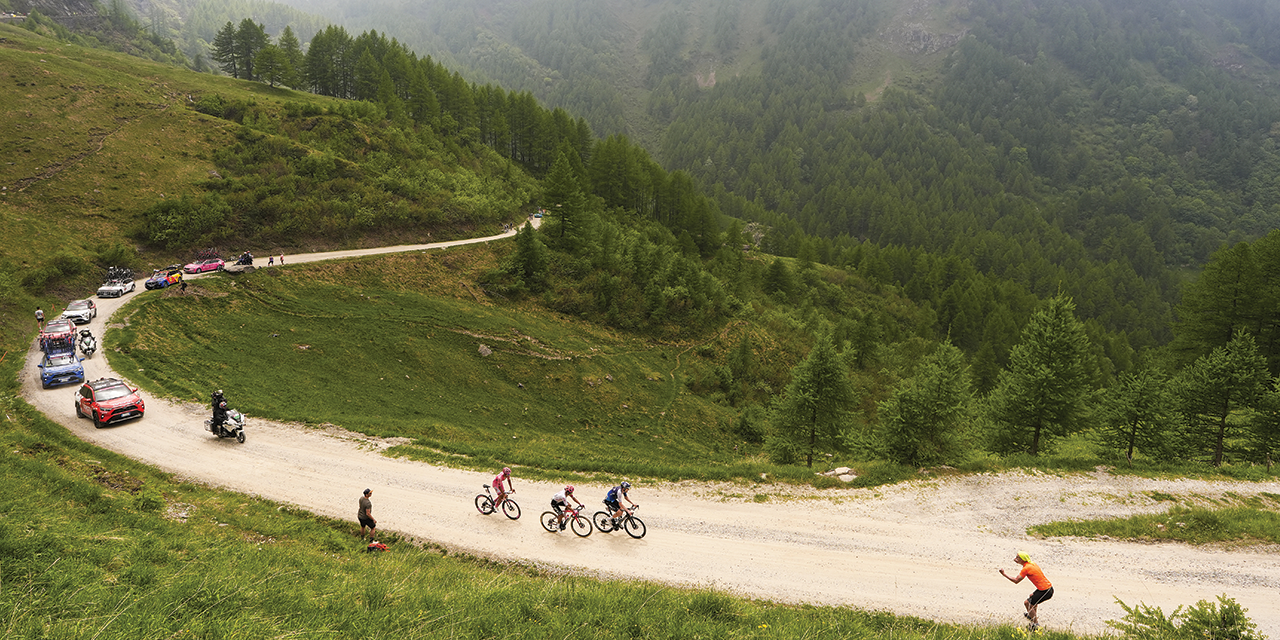
The numbers are savage: 18.5 km at an average gradient of 9.2%, relentlessly steep from bottom to top. As if that weren’t enough, the final 8 km are on gravel, turning the climb into a grinding, leg-shattering ordeal.

Connecting the Susa Valley to Val Chisone, Finestre will shred the legs of every contender. But the stage isn’t over at the summit: after an 11 km descent, the riders face Sestrière (16.2 km at 3.8%). It may look manageable, but after Finestre, even the slightest incline can feel like a wall. By the finish line, the verdict will likely be in: this is where the Giro d’Italia Women could be decided.

Montoso

After the brutality of Finestre, the race still has one final sting in the tail. Stage 9, starting and finishing in Saluzzo, features Montoso, the last real climb of the race.

If the general classification is still tight, this ascent could turn into pure chaos. Montoso is no gentle farewell: 8.9 km at an average gradient of 9.4%, set on the Piedmont side of the Cottian Alps, beneath the imposing Monviso, above Bagnolo Piemonte.
Its main caveat? Positioning. The summit comes a full 88 km from the finish, meaning the GC favourites might be tempted to ride conservatively. But if anyone dares to attack early – or if the standings are still razor-thin – this climb could blow the race wide open.

In that case, expect fireworks all the way to the final finish line, with the Giro d’Italia Women ending in true, heart-pounding style.

Follow us
on social media
#GirodItaliaWomen
top sponsor
official partners
institutional partners
official suppliers